The UK clinical trial landscape is facing its biggest shake-up in twenty years. From 28 April 2026, the Medicines for Human Use (Clinical Trials) (Amendment) Regulations 2025 come into force - and the way sponsors, CROs and sites handle participant payments is no longer just an admin question. It’s a compliance risk.
We’ve been hearing the same questions from trial teams across the UK. So we’ve put the most pressing ones in one place - with straight answers.
vHelp is a UK-based payment platform that reimburses clinical trial participants directly to their bank account within 24 hours - with a regulator-ready audit trail built in from day one.
What exactly is the “BACS Governance Trap”?
Your regulations changed. Your payment system didn't. That gap is the problem.
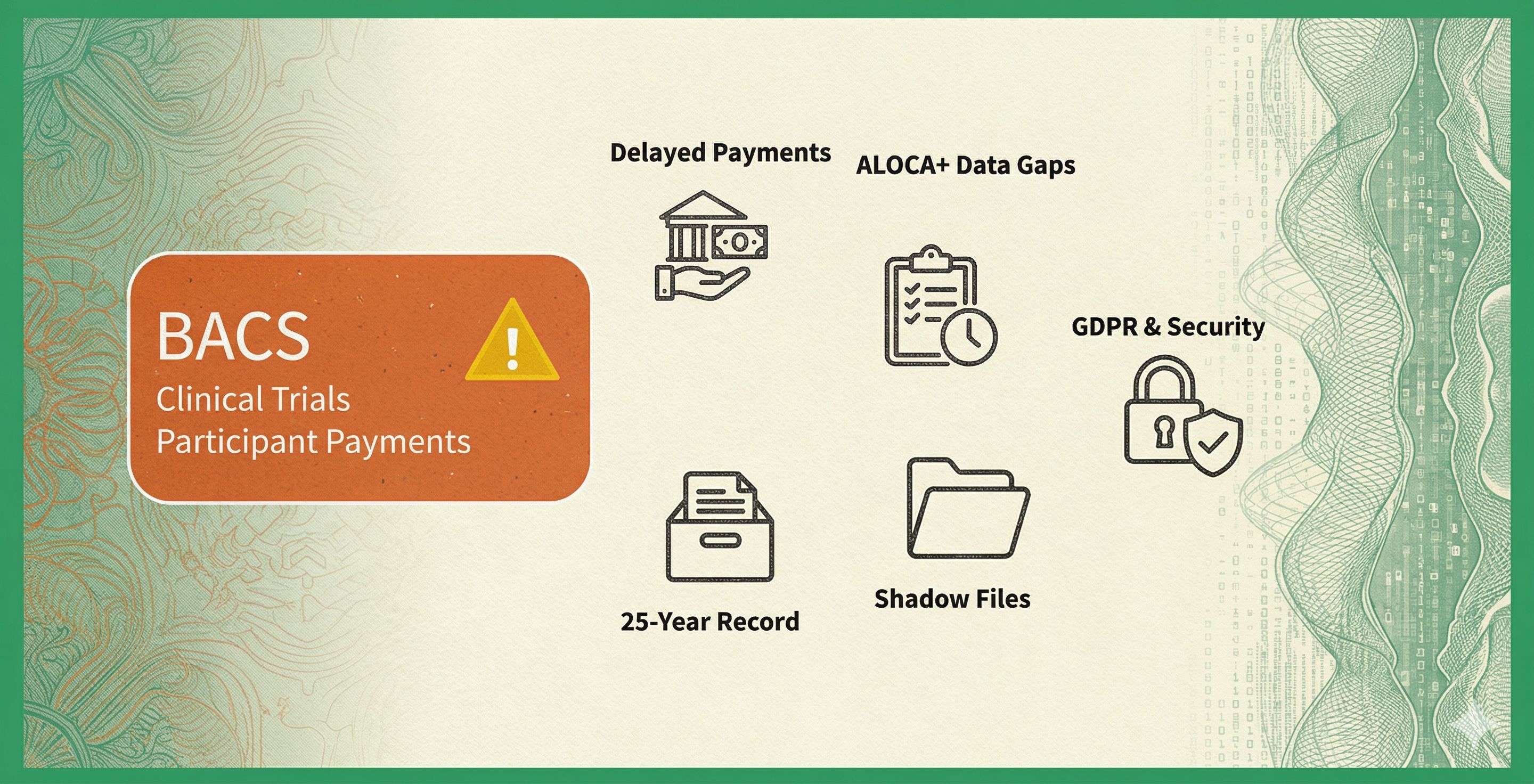
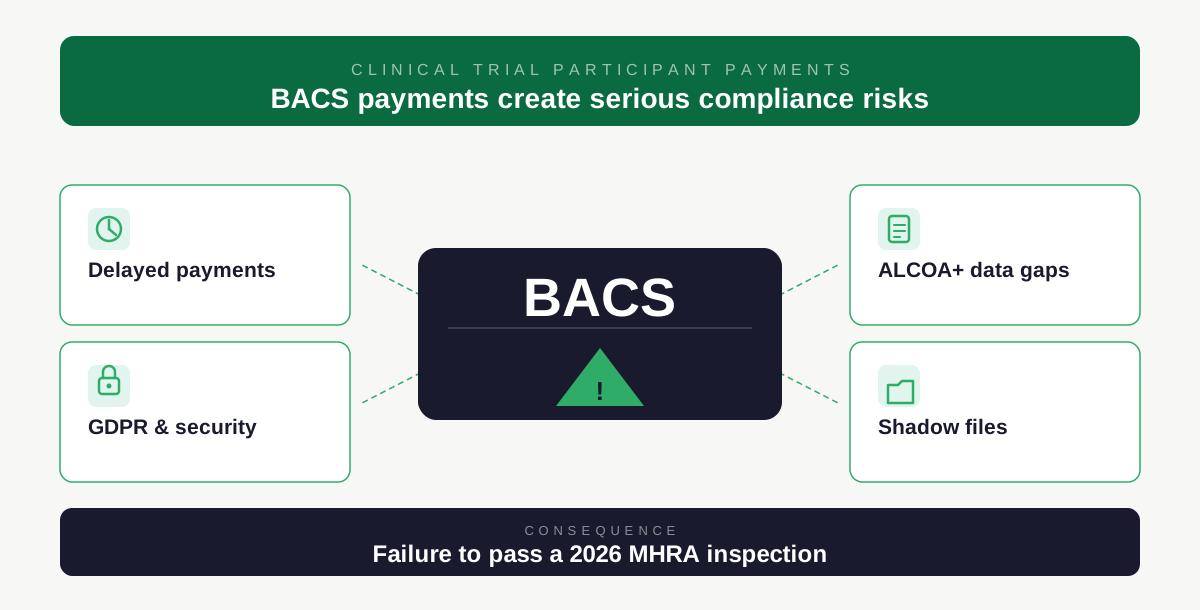
Many UK trial sites still rely on manual BACS transfers to pay participants. That typically means a 4-12-week lag between a participant’s site visit and the money landing in their account. Under the 2026 rules, that delay doesn’t just hurt retention - it creates fragmented, incomplete audit trails that are nearly impossible to reconstruct if an MHRA inspector comes knocking.
The “trap” is this: the system worked well enough before. It no longer does.
How do the 2026 regulations change archiving for participant records?
The shift is significant. Regulation 31A extends mandatory archiving for Trial Master Files and participant records from 5 years to at least 25 years. That includes all essential records and their metadata.
Think about what that means practically. If your participant payment records are sitting in a spreadsheet on someone’s laptop, or buried in a finance inbox, you have no reliable way to guarantee they’ll be readable, retrievable or intact in 2051.
That’s not a future problem. It’s a right-now problem, because the systems you’re using today are the ones you’ll be expected to produce records from in 25 years.
What does ALCOA++ have to do with participant payments?
Historically, ALCOA++ - the data integrity framework covering Attributable, Legible, Contemporaneous, Original, Accurate, and more - was applied to clinical data. What’s changed is that the MHRA now expects the same standards for financial audit trails.
In practice, that means every participant payment needs to be:
- Attributable - linked to a specific individual, not processed through a shared login
- Contemporaneous - documented at the time of the visit, not batched and processed weeks later
- Enduring - stored in a validated system that will hold up for 25 years
- Participants are 2.5 times more likely to complete a trial when they’re not left out-of-pocket between visits
- Trial teams have a single, auditable record of every payment - ready for inspection
- All data is handled in a GDPR-native environment with UK data sovereignty - no retrofitting required
Manual BACS processes fail on all three. That’s the problem.
Why is email a compliance risk for handling participant bank details?
Because it’s one wrong recipient away from an ICO-notifiable breach.
Sending participant bank details over email - even internally - is a data security risk that’s hard to justify under UK GDPR. Human error is consistently one of the leading causes of personal data breaches reported to the ICO. And in a clinical trial context, the individuals involved are research participants, which brings additional sensitivity obligations.
The broader issue is what compliance teams call “Shadow IT” - unofficial tools like unencrypted spreadsheets or shared inboxes that get used because they’re convenient. They have no immutable audit trail. They don’t meet ALCOA++ standards. And they won’t pass an MHRA inspection.
How does vHelp address the participant reimbursement and compliance challenges created by the 2026 rules?
vHelp replaces the manual lag with digital speed and replaces the compliance risk with a system built to meet the 2026 rules.
Participants receive their reimbursement direct to bank within 24 hours of approval. Every payment generates an automatic, immutable audit trail that satisfies ALCOA++ and Regulation 31A requirements. No spreadsheets. No email. No chasing.
Three things follow from that:
- Participants are 2.5 times more likely to complete a trial when they’re not left out-of-pocket between visits
- Trial teams have a single, auditable record of every payment - ready for inspection
- All data is handled in a GDPR-native environment with UK data sovereignty - no retrofitting required
Ready to see how vHelp works for your trial?
Request a demo by emailing us on hello@vhelp.co.uk